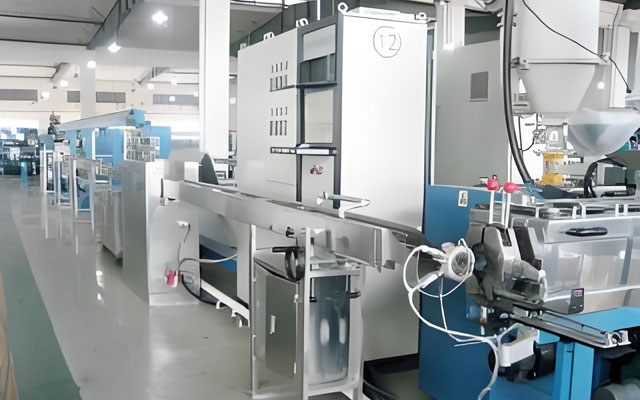
Model 50-65Screw Diameter φ50-65 mmL/D Ratio /Extrusion Output /Main Motor /Outlet Diameter Φ3-25 mmSpeed 150-200 m/minApplication Optical cable
Optical Cable Extrusion Line
An optical cable extrusion production line, commonly referred to as an extrusion line or sheathing line, is an industrial production system that uses an extrusion molding process to tightly coat one or multiple layers of polymer sheath onto the cable core (the component where the optical fibers have already been cabled) of an optical cable.
The fundamental purpose of the extrusion production line is to provide "armor" for the fragile optical cable core. This sheath is crucial for:
Mechanical Protection: Resists external forces such as tension, compression, bending, and impact.
Environmental Protection: Prevents the ingress of moisture and water, resists UV radiation, and protects against chemicals and oil corrosion.
Insulation and Identification: Provides electrical insulation and allows for identification through different colors, facilitating installation and maintenance.
Without a high-quality extruded sheath, optical cables could not function stably long-term in complex outdoor environments.
Main Components
A complete optical cable extrusion production line is a complex system consisting of the following core components, arranged according to the process flow:
Pay-off SystemFunction: To release the cable core to be sheathed smoothly and controllably.
Key Requirement: Must maintain constant tension to avoid sudden pulling or slack that could damage the cable core or cause eccentric sheathing. Typically uses active pay-off or passive brake pay-off methods.
Preheating and Cleaning SystemPreheating Device: Preheats the cable core before it enters the die head using electric heating or hot air.
Purpose: Removes moisture from the cable core surface and raises its temperature, promoting better adhesion between the molten sheath material and the core, preventing "delamination," and improving bonding.
Cleaning Device: Uses brushes, high-pressure air, etc., to remove dust and impurities from the cable core surface.
Purpose: Ensures no impurities between the sheath and core, guaranteeing sheath quality.
Extruder SystemThis is the "heart" of the production line, responsible for melting, plasticizing, and steadily extruding the solid plastic pellets.
Hopper: Used for storing and feeding plastic pellets (e.g., PE, PVC, LSZH, Nylon).
Screw and Barrel:
Screw: The core component of the extruder. Its design (e.g., length-to-diameter ratio, compression ratio) directly determines plasticization quality and output. It is divided into feed section, compression section, and metering section based on function.
Barrel: Houses the screw, equipped with external heating bands, and withstands high internal pressure.
Drive Motor: Provides rotational power for the screw.
Heating and Cooling System: Precisely controls the temperature of each zone of the barrel to ensure the plastic melts and plasticizes at the optimal temperature.
Die Head and MoldThis is the "throat" that determines the final shape and quality of the sheath.
Die Head: The component connecting the extruder to the mold. Its internal flow channel design is crucial, ensuring molten plastic flows evenly and without dead spots towards the mold.
Mold: Includes the tip and die.
Tip: Determines the inner diameter of the sheath; the cable core passes through it.
Die: Determines the outer diameter and surface finish of the sheath.
The fit between the tip and die determines the sheath thickness and extrusion method (e.g., pressure extrusion, semi-tubular, tubed).
Cooling SystemFunction: To rapidly and uniformly cool and solidify the freshly extruded, high-temperature molten sheath.
Structure: Typically a long, segmented water trough.
Key Requirement: Cooling must be gradual. Water temperature is controlled segmentally from high to low to avoid stress cracking or the appearance of "rice grain" pores in the sheath due to sudden cooling.
Puller SystemFunction: Provides stable, continuous pulling force to draw the finished sheathed optical cable from the end of the production line.
Type: Typically uses a caterpillar puller, which grips and pulls the cable using two synchronized rubber tracks.
Key Requirement: Speed must be strictly synchronized with the extruder's output to ensure stable cable diameter. The stability of the puller speed is key to ensuring uniform sheath thickness.
Take-up SystemFunction: To wind the finished optical cable neatly and orderly onto a reel.
Key Requirement: Synchronized with the puller system and equipped with traversing functionality to layer the cable neatly on the reel, avoiding tangling and crushing.
Control System and Measurement Devices - The "Brain" of the Production Line
Control System: Modern lines are entirely controlled by PLCs and industrial computers, integrated into a control cabinet. Operators can set and monitor all process parameters here (e.g., zone temperatures, screw speed, puller speed, tension).
Measurement Devices:
Diameter Gauge: Monitors the sheath outer diameter in real-time online and feeds data back to the control system for automatic adjustment.
Spark Tester: Used during production to check the integrity of the sheath. Applies high voltage to detect defects like pinholes or breaks in the sheath.
Printer: Prints identification on the optical cable sheath, such as manufacturer, meter mark, model, etc.
Optical Cable Extrusion Line Datasheet
| Model |
50 |
65 |
| Tight-buffered Fiber Diameter |
0.6/0.9 mm |
0.6/0.9 mm |
| Flexible Optical Cable Dimensions |
φ2-3 mm |
Φ3-25 mm |
| Line Structure Speed |
200 m/min |
150 m/min |
| Fiber Pay-off Tension |
0.4N~3N |
0.8N~5N |
| Extruder |
φ50 |
φ65 |
| Take-up Tension |
5N~50N (adjustable) |
5N~300N (adjustable) |
| Take-up Reel Size |
630 |
1250 |
| Production Line Direction |
To be specified by customer |
To be specified by customer |
| Equipment Color |
To be specified by customer |
To be specified by customer |
Optical Cable Extrusion Line Application
The optical cable extrusion production line is standard equipment in optical cable manufacturing plants, and its applications cover the sheathing production for all types of optical cables.
Application by Cable TypeOutdoor Cables: This is the primary application. Produces black high-density polyethylene sheaths for outdoor cables used in direct burial, aerial, and duct installations. Often requires two layers: inner sheath and outer sheath, potentially with an armor layer in between.
Indoor Cables: Produces sheaths from flame-retardant materials for cables used inside buildings, such as PVC or Low Smoke Zero Halogen (LSZH) compounds.
Drop Cables / Patch Cables: Produces the butterfly-shaped cables used for FTTH; their unique flat shape is formed by special mold extrusion.
Special CablesSubmarine Cables: Extrudes extremely thick, highly sealed multi-layer PE sheaths.
Optical Fiber Composite Cables: Sheaths cable cores containing both optical fibers and electrical wires.
Rodent-Proof Cables: Produces sheaths using special materials (e.g., glass fibers) or hard Nylon.
Application by Sheath LayerPrimary Coating: A thin sheath extruded directly onto the fiber bundle or tight-buffered fibers, providing initial bundling and protection.
Inner Sheath: A layer extruded over the cable core (which may already include primary coating, strength members, fillers, etc.), primarily serving for cabling structure and buffering.
Outer Sheath: The outermost layer, in direct contact with the external environment, providing the final mechanical and environmental protection.