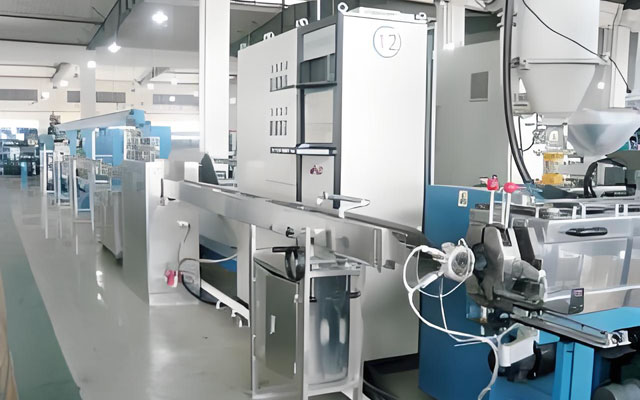
Model 50Screw Diameter φ50 mmL/D Ratio /Extrusion Output /Main Motor /Outlet Diameter /Speed 200 m/minApplication Single-core soft optical fiber cable
Single-Core Soft Optical Fiber Cable Extrusion Line
A single-core soft optical fiber cable extrusion production line is a specialized set of automated industrial equipment used for manufacturing single-core soft optical fiber cables. Its core process involves using an extruder to uniformly coat a pre-prepared optical fiber (typically a tight-buffered fiber or bare fiber) with molten plastic (such as PVC, LSZH, Nylon, etc.), forming a protective tight buffer layer, ultimately producing a soft, lightweight, flexible, and easily spliced single-core optical fiber cable.
This type of cable is the most basic and simplest unit in optical communication networks. Its structure is typically: Central Optical Fiber → Tight Buffer Layer → (Optional) Aramid Yarn Strengthening Member → Outer Sheath. The task of the extrusion production line is to efficiently, stably, and high-quality complete the extrusion and formation of the tight buffer layer and the outer sheath.
Characteristics
High Precision: Requires extremely high control over fiber pay-off tension, extrusion thickness, outer diameter, and concentricity to ensure the optical and mechanical performance of the cable.
High Speed: Modern production lines can reach speeds of hundreds of meters per minute, ensuring high production efficiency.
Automation: Integrates PLC (Programmable Logic Controller) and industrial computers to achieve fully automated control from pay-off, preheating, extrusion, cooling, diameter measurement, pulling, to winding.
Flexibility: By changing the extruder head, molds, and adjusting process parameters, it can produce single-core soft optical fiber cables of different specifications, colors, and materials.
Production Line Composition
A complete single-core soft optical fiber cable extrusion production line consists of the following core systems and units, arranged in the order of the process flow:
1. Pay-Off SystemFunction: To release the central element, i.e., the bare fiber or colored fiber, smoothly and constantly.
Composition:
Pay-Off Stand: Typically uses active or passive pay-off methods, equipped with a precision tension control system to ensure minimal and constant tension during the pay-off process, avoiding fiber damage or micro-bend loss due to excessive tension.
Accumulator (Optional): Ensures continuous operation without interruption during pay-off spool changes.
2. Pre-Treatment UnitFunction: To perform necessary treatment on the optical fiber before extrusion to improve the adhesion between the tight buffer layer and the fiber.
Composition:
Pre-Heater: Gently heats the fiber to remove surface moisture and brings the fiber temperature closer to that of the molten plastic upon entering the die, reducing internal stress and improving coating quality.
Cleaning Device: Uses lint-free cloth or brushes to remove dust and impurities from the fiber surface.
3. Extrusion SystemFunction: To melt and plasticize solid plastic pellets and extrude them quantitatively and under constant pressure onto the fiber surface.
Core Components:
Extruder:
Barrel and Screw: The screw rotates within the barrel, melting the plastic pellets through shear heat and external heaters. Screw design (such as length-to-diameter ratio, compression ratio) is crucial for plastification output.
Heating and Cooling System: Precisely controls the temperature of each zone of the barrel through multi-zone temperature-controlled heating bands and cooling fans.
Drive Motor: Provides power for the screw rotation, usually an AC variable frequency motor, enabling stepless speed regulation.
Extruder Head and Die:
Head: The flow channel component connecting the extruder and the die.
Die: This is key to determining the cable structure. For single-core tight-buffered cables, a pressure die is typically used. The die consists of a tip and a die, with molten plastic passing through the annular gap between them to uniformly coat the optical fiber.
4. Cooling SystemFunction: To rapidly set and solidify the molten plastic sleeve immediately after it exits the die.
Composition:
Cooling Trough: One or multiple segmented long troughs filled with circulating cooling water.
Water Level and Temperature Control: Precisely controls water level and temperature to ensure a gentle and uniform cooling process, avoiding internal stress and out-of-roundness caused by rapid cooling.
5. Online Monitoring and Control SystemFunction: To monitor and adjust key parameters in the production process in real-time, ensuring product quality.
Core Equipment:
Laser Diameter Gauge: Measures the outer diameter and concentricity of the extruded cable in a non-contact manner, feeding data back to the control system to automatically adjust puller speed or extrusion output, achieving closed-loop control.
Spark Tester (For sheathed cables): Used to detect the insulation integrity of the sheath, ensuring no breaks, pinholes, or other defects.
PLC and Industrial PC HMI: Centrally controls the operation of the entire production line, including all parameters such as temperature, speed, and tension, and records production data.
6. Pulling SystemFunction: To provide stable, continuous pulling force, smoothly drawing the cable from the extruder towards the take-up spool.
Composition:
Caterpillar Puller or Capstan Puller: Grips the cable via rubber tracks or V-grooved wheels, providing uniform pulling force without slippage. Typically equipped with an encoder for synchronization with the extruder and take-up system.
7. Take-Up SystemFunction: To wind the finished cable neatly and tightly onto the take-up spool.
Composition:
Take-Up Stand: Usually employs active take-up, equipped with a traverser to arrange the cable neatly on the spool.
Tension Control: Maintains constant winding tension to avoid damage from excessive tightness or messy winding from excessive looseness.
8. Auxiliary EquipmentColor Masterbatch Mixing System: Automatically mixes color masterbatch with the base material in proportion to produce cables of different colors for identification.
Printing Device: Continuously prints information such as brand, model, and meter marks onto the cable sheath.
Single-Core Soft Optical Fiber Cable Extrusion Line Datasheet
| Model |
50 |
| Tight-buffered Fiber Diameter |
0.6/0.9 mm |
| Flexible Optical Cable Dimensions |
φ2-3 mm |
| Line Structure Speed |
200 m/min |
| Fiber Pay-off Tension |
0.4N~3N |
| Extruder |
φ50 |
| Take-up Tension |
5N~50N (adjustable) |
| Take-up Reel Size |
630 |
| Production Line Direction |
To be specified by customer |
| Equipment Color |
To be specified by customer |
Single-Core Soft Optical Fiber Cable Extrusion Line Application
Single-core soft optical fiber cables are extremely widely used in the following fields due to their simple structure, softness, and lightweight advantages:
1. Fiber-to-the-Home / In-Building CablingThis is the largest application area. Single-core soft optical fiber cables (typically tight-buffered) are used as drop cables for FTTH (Fiber-to-the-Home) and indoor cables, connecting directly from the distribution point in the building to the Optical Network Terminal (ONT) in the user's home. Their flexibility allows for easy installation along corners, door and window edges.
2. Equipment Interconnection & Patch CordsSingle-core or dual-core soft optical fiber cables become fiber optic patch cords when connectors (e.g., LC, SC, ST) are attached to both ends, widely used in:
Data Centers: Connections between servers and switches, switches and core routers.
Telecommunication Rooms: Cross-connections between ODFs (Optical Distribution Frames).
Local Area Networks (LANs): Interconnections between various optical communication equipment.
3. Sensing SystemsIn the field of fiber optic sensing, single-core cables are used as sensing elements or signal transmission media for:
Perimeter Security Systems: Vibration sensing cables.
Oil and Gas Pipeline Monitoring: Distributed Temperature/Acoustic Sensing.
Power System Monitoring: Temperature monitoring of transformers and power cables.
4. Medical and Industrial EquipmentDue to their small size, high flexibility, and immunity to electromagnetic interference, they are used in:
Imaging fiber bundles in medical endoscopes.
Illumination and signal transmission for industrial machine vision systems.
Energy transmission for laser equipment.
5. Automotive and AerospaceWith increasing bandwidth demands in vehicle networks and onboard networks, lightweight single-core optical cables are finding applications in automotive buses (e.g., MOST, Ethernet AVB) and aircraft internal communication networks.
6. Consumer Electronics and Audio/Video SystemsUsed for audio signal transmission (TOSLINK interface) in high-end home theaters and professional recording studios, enabling lossless digital audio transmission.