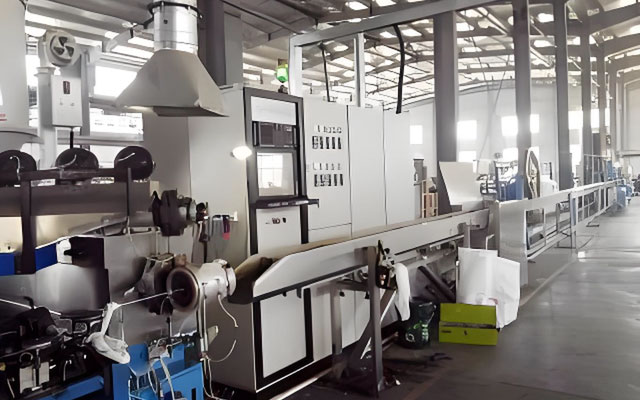
Model 90Screw Diameter φ90 mmL/D Ratio /Extrusion Output 260 Kg/hMain Motor 90 KWOutlet Diameter 4.5-30 mmSpeed ≥80 m/minApplication Optical cable sheath
Optical Cable Sheath Extrusion Line
An optical cable sheath extrusion production line is a specialized set of automated industrial equipment used for extruding one or multiple polymer outer sheaths onto the optical cable core (the central component already integrating optical fibers, strengthening members, buffer layers, etc.). Its core process involves using an extruder to continuously, uniformly, and densely coat the cable core with molten plastic (such as PE, PVC, LSZH, TPU, etc.), forming the final protective layer.
Core Functions of the Sheath
Mechanical Protection: Resists mechanical stresses such as tension, crushing, impact, and bending during installation and use.
Environmental Protection: Prevents erosion of the internal cable core by moisture, humidity, chemicals, UV radiation, rodents, etc.
Electrical Insulation: Provides electrical insulation, especially for metal-armored optical cables.
Identification: Provides information such as cable type, brand, and meter marks through color and printing.
Production Line Characteristics:
High Reliability: The production line must be stable and reliable, ensuring the sheath is continuous and defect-free, as any interruption can lead to significant material and time losses.
Strong Adaptability: Capable of handling cable cores of various structures (such as central tube, stranded, ribbon) from indoor soft cables to outdoor duct, direct burial, and aerial cables.
Precision Control: Extremely high control accuracy over key parameters such as sheath thickness, outer diameter, concentricity, and adhesion.
High Efficiency: Modern production lines operate at high speeds and can achieve long-length continuous production through large-capacity take-up and traversing systems.
Production Line Composition
A complete optical cable sheath extrusion production line mainly consists of the following systems, arranged in the order of the process flow:
1. Pay-Off SystemFunction: To smoothly and constantly release the cable core, which has already completed its inner layer structure.
Composition:
Heavy-Duty Pay-Off Stand: Usually active or passive type, with strong load-bearing capacity, capable of accommodating cable core reels weighing several tons.
Tension Control System: Precisely controls the pay-off tension of the cable core, preventing damage to internal fibers from excessive tension or core arching in the equipment due to excessive slack.
Core Straightening Device (Optional): Eliminates the natural curvature of the cable core from the reel, ensuring it enters the extruder head straight.
2. Pre-Treatment Unit Function: To improve the adhesion between the sheath and the cable core (for bonded sheath types).
Composition:
Pre-Heater: Heats the cable core to remove moisture and bring the core surface temperature closer to the molten plastic temperature, reducing internal stress and enhancing adhesion.
Corona Treater (Optional): Alters the surface polarity of the cable core sheath (e.g., PE sheath) through high-voltage discharge, significantly improving interlayer adhesion.
3. Extrusion SystemFunction: To melt, plasticize plastic pellets, and extrude them quantitatively.
Core Components:
Extruder:
Specifications: According to cable diameter and output, models like SJ90, SJ120, SJ150 are commonly used.
Screw and Barrel: Optimized for different plastics (e.g., PE requires barrier screws) to ensure efficient, pulse-free extrusion.
Heating and Cooling: Multi-zone independent temperature control for precise control of the plasticizing process.
Extrusion Die:
Types: Mainly divided into Pressure Die and Semi-Pressure (Tubing) Die.
Pressure Die: The sheath is tightly pressed onto the cable core, providing firm adhesion, mainly used for outdoor cables requiring high moisture resistance.
Semi-Pressure Die: The sheath combines more loosely with the cable core, making the cable more flexible with better bending performance, mainly used for indoor cables or microducts.
Structure: Consists of a Tip (determines the inner diameter) and a Die (determines the outer diameter). Their matching precision directly determines the concentricity of the sheath.
4. Cooling SystemFunction: To set and solidify the molten sheath.
Composition:
Segmented Cooling Trough: Can be 20-30 meters long, divided into 2-4 sections.
Gradient Cooling: The first section uses warm water (to prevent internal stress from rapid cooling), subsequent sections use cold water (to improve production efficiency).
Vortex or Spray Cooling: Ensures uniform cooling, preventing ovality from exceeding standards.
5. Online Monitoring and Control SystemFunction: To monitor, record, and automatically adjust process parameters in real time.
Core Equipment:
Laser Diameter Gauge: Monitors the sheath outer diameter and concentricity in real time, and links with the puller speed for closed-loop control.
Spark Tester: Mandatory equipment. Applies high voltage to the sheath to detect defects such as pinholes or skin breaks, ensuring sheath integrity.
Thickness Gauge (Optional): Measures the sheath's minimum and maximum points in real time via ultrasound or X-ray.
Printing Monitor: Checks if the printing is clear and complete.
PLC + Industrial Touch Screen: Centrally controls all units and stores production process recipes.
6. Pulling SystemFunction: Provides the main pulling force, determining the production line speed.
Composition:
Dual Caterpillar Puller: Mainstream configuration. The upper and lower tracks with rubber blocks provide huge and uniform clamping force for non-slip traction of heavy cables.
7. Take-Up SystemFunction: To wind the finished optical cable neatly and tightly onto the take-up reel.
Composition:
Large Take-Up Stand: Possesses strong torque; take-up tension can automatically decrease as the reel diameter increases.
Precision Traverser: Ensures the cable is arranged neatly layer by layer on the reel.
Automatic Reel Change System (High-end configuration): Achieves automatic reel switching without stopping the line, greatly improving efficiency.
8. Auxiliary EquipmentLength Meter: High-precision length measurement for controlling production length and printing meter marks.
Inkjet Printer: Continuously prints identification on the sheath.
Capstan Puller (Optional): Located before take-up, creates tension isolation from the main puller, ensuring stable take-up tension.
Optical Cable Sheath Extrusion Line Datasheet
| Model |
90 |
| Cable Core Outer Diameter |
2.5-25 mm |
| Extruded Sheath Outer Diameter |
4.5-30 mm |
| Line Structure Speed |
≥80 m/min (for diameters below 12 mm) |
| Extruder |
φ90 |
| Main Extruder Output |
260 Kg/h |
| Extruder Main Motor |
90 KW |
| Production Line Direction |
To be specified by customer |
| Equipment Color |
To be specified by customer |
| Production Line Center Height |
1000 mm |
Optical Cable Sheath Extrusion Line Application
The optical cable sheath extrusion production line is a universal platform for optical cable manufacturing. Its products cover all types of optical cables, with applications across all fields:
1. Communication Trunk NetworksOutdoor Cables: Such as Aerial Cables, Duct Cables, Direct Burial Cables. Typically use black high-density polyethylene sheathing with excellent weatherability, UV resistance, and hydrolysis resistance.
Armored Cables: Incorporate steel tape or wire armor within the sheath for use in environments requiring rodent protection or resistance to heavy pressure.
2. Fiber-to-the-Home NetworksDrop Cables and Indoor-Outdoor Cables, typically featuring flame-retardant sheathing (LSZH) and good bending performance.
3. Data CentersIndoor Tight-Buffered Cables, Pre-connectorized Cables (e.g., MPO patch cords). Sheathing is usually PVC or Low Smoke Zero Halogen (LSZH) material, available in various colors for easy distinction.
4. Special Application FieldsSubmarine Cables: Feature complex multi-layer sheaths and armor. The production line requires extreme stability and precision.
Military Field Cables: Require sheathing with extreme abrasion resistance, oil resistance, and tear resistance.
Mining Cables: The sheath must have flame-retardant and anti-static properties.
Automotive/Aerospace Cables: Require sheathing that is lightweight, high-temperature resistant, and flame retardant.
Sensing Cables: Such as distributed temperature sensing cables, requiring high temperature resistance and signal consistency from the sheath.