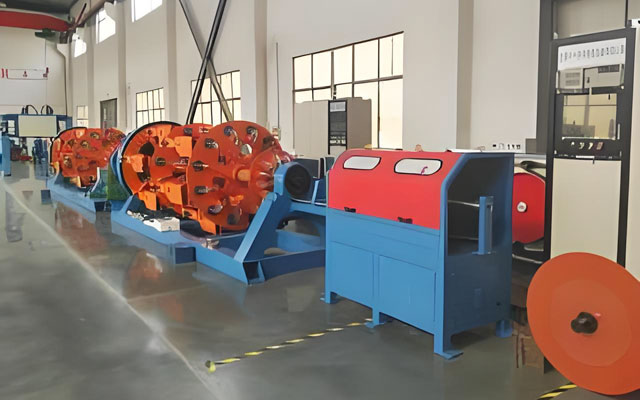
Model 65Screw Diameter φ65 mmL/D Ratio /Extrusion Output /Main Motor /Outlet Diameter 7-25 mmSpeed 150 m/minApplication Multi-core soft optical fiber cable
Multi-Core Soft Optical Fiber Cable Sheathing Extrusion Line
A multi-core soft optical fiber cable typically refers to a lightweight cable with a fiber count above 2 cores (common counts are 4, 6, 8, 12, 24, etc.). A multi-core soft optical fiber cable sheathing extrusion production line is a specialized set of equipment used for manufacturing the outer sheath of multi-core soft optical fiber cables. Its core process involves using an extruder to uniformly coat multiple, already bundled, optical fibers (usually colored and gathered tight-buffered fibers or bare fibers) and strengthening members (such as aramid yarn, fiber yarn) with molten polymer material (e.g., PVC, LSZH, TPU, PE), forming the final protective outer sheath.
The structure of this cable is typically: Multiple tight-buffered/bare fibers → Bundling (parallel or stranded) → Strengthening member (aramid yarn, etc.) → Outer sheath. The core tasks of the production line are to ensure:
Uniform Bundling: Multiple fibers are evenly distributed inside the sheath, without crossing or twisting.
Stable Structure: The sheath is tightly integrated with the internal structure, possessing good tensile, compressive, and bending resistance.
Precise Dimensions: The sheath's outer diameter, thickness, and roundness comply with high standard requirements.
Production Line Characteristics:
High-Precision Bundling Control: Equipped with complex fiber guiding, bundling, and alignment devices to ensure multiple fibers enter the die with low tension and minimal stress.
High-Torque Extrusion: Due to the thicker object being coated and higher fill level, the extruder requires stronger plasticizing capacity and output stability.
Complex Tension Synergy: Requires coordinating the tension from multiple pay-off units and synchronizing with the pulling and take-up systems to prevent fiber arching or stretching damage.
Intelligent Monitoring: Uses advanced sensors and control systems to monitor sheath quality, fiber status, and production line operation in real-time.
Modularity and Flexibility: By changing bundlers, dies, etc., it can quickly switch between producing multi-core cables with different core counts and structures (e.g., parallel, stranded).
Production Line Composition
A complete multi-core soft optical fiber cable sheathing extrusion production line mainly consists of the following systems:
1. Multi-Unit Pay-Off SystemFunction: To smoothly and synchronously release multiple optical fibers (or fiber bundles) and strengthening members.
Composition:
Multi-Fiber Pay-Off Stand: Uses multiple independent active or passive pay-off units, each equipped with a precision tension controller to ensure the tension for each fiber is minimal and consistent. Often arranged in a linear or rotary turret configuration.
Strengthening Member Pay-Off Stand: Used for releasing strengthening elements like aramid yarn or fiberglass yarn, also requiring precise tension control.
Accumulator: Ensures continuous production line operation when replacing any pay-off spool.
2. Bundling and Guidance System - Key for Multi-Core ProductionFunction: This is the most crucial difference from single/dual-core lines. It precisely guides, arranges, and gathers the multiple fibers from the various pay-off stands into the predetermined structure (parallel or slightly stranded).
Composition:
Guide Wheel Assemblies: A series of precision ceramic or diamond-coated guide wheels that independently guide each fiber.
Bundler/Bundling Die: A device with multiple precision micro-holes. All fibers pass through their respective holes and are gathered into a regular circular bundle at the exit. This is the core component ensuring uniform fiber distribution within the sheath.
Alignment Device: Eliminates bending stress generated in the fibers during the pay-off process.
3. Extrusion SystemFunction: To plasticize and extrude the sheath material.
Core Components:
Extruder: Typically uses a screw with a larger length-to-diameter ratio (e.g., 25:1 or above) to ensure sufficient and uniform plasticization. The drive motor is more powerful to handle higher loads.
Multi-Core Specialized Sheathing Die: Usually employs a semi-tube type die. This type of die allows the strengthening members and fiber bundle to pass through the tip with less pressure, while the sheath material is extruded and coated at the die, better protecting the internal structure and avoiding crushing the fibers. The die design must ensure extremely balanced melt flow to avoid core misalignment or weld lines.
4. Cooling SystemFunction: To fully and uniformly cool and set the sheath.
Composition:
Segmented Cooling Trough: Usually divided into 2-3 stages. The first stage uses warm water for slow cooling to reduce internal stress; subsequent stages use cold water for rapid cooling to improve production efficiency.
Vortex Spray Cooling (Advanced configuration): Achieves efficient and uniform cooling through water jet spray, especially suitable for thick sheaths or high fiber count cables.
5. Online Monitoring and Control SystemFunction: To comprehensively monitor the production status and ensure product quality is foolproof.
Core Equipment:
Laser Diameter Gauge: Monitors the sheath outer diameter and roundness in real-time and performs closed-loop control.
Ultrasonic Diameter Gauge (Optional): Can be installed behind the die to measure the sheath diameter at high temperatures, enabling earlier intervention.
Spark Tester: Mandatory, used to detect the continuity of the sheath, ensuring there are no pinholes, skin breaks, or other defects.
Multi-Channel Tension Monitor: Monitors the tension of fibers and strengthening members at key points.
Industrial Computer and PLC: Acts as the central control unit, integrating all data, enabling recipe management, parameter recording, and fault diagnosis.
6. Pulling SystemFunction: To provide strong, stable, non-slip pulling force.
Composition:
Dual Caterpillar Puller: The mainstream configuration. The upper and lower tracks provide even pressure, ensuring no slippage when pulling large-gauge, multi-core cables. Typically equipped with high-precision encoders for length measurement and synchronization.
7. Take-Up SystemFunction: To wind the finished cable neatly and tightly onto large reels or drums.
Composition:
Large Take-Up Stand: Possesses powerful drive capability, with programmable take-up tension control.
Precision Traverser: Automatically adjusts the traverse pitch according to the cable diameter, ensuring neat winding and avoiding crushing.
8. Auxiliary EquipmentAutomatic Length Meter: Linked with the puller encoder to precisely control the winding length and spray meter marks.
Inkjet Printer: Continuously and clearly prints information like brand, model, meter marks, and production date onto the sheath.
Concentricity Monitor and Controller (Optional): Monitors and adjusts the sheath concentricity in real-time.
Multi-Core Soft Optical Fiber Cable Sheathing Extrusion Line Datasheet
| Model |
65 |
| Tight-buffered Fiber Diameter |
0.6/0.9 mm |
| Maximum Sub-Cable Diameter |
φ3 mm |
| Maximum Soft Optical Cable Diameter |
φ25 mm |
| Line Structure Speed |
150 m/min |
| Fiber Pay-off Tension |
0.8N~5N |
| Extruder |
φ65 |
| Take-up Tension |
5N~300N (adjustable) |
| Take-up Reel Size |
1250 |
| Production Line Direction |
To be specified by customer |
| Equipment Color |
To be specified by customer |
| Production Line Center Height |
1000 mm |
Multi-Core Soft Optical Fiber Cable Sheathing Extrusion Line Application
Multi-core soft optical fiber cables are the primary medium for building the backbone and branches of medium-density fiber optic networks and are extremely widely used:
1. Building and Campus Structured CablingServes as Riser Backbone Cables and Horizontal Subsystem Cables, connecting distribution frames on different floors within a building, or different buildings within a campus. Core counts are typically 12, 24, etc.
2. Fiber-to-the-Home/BuildingIn FTTH networks, serves as Feeder Cables, deployed from the central office to the optical splitter points in communities or building corridors, providing access capacity for multiple users.
3. Data Center InterconnectUsed for Interconnect Cables between different cabinets, different rows of switches within the same data center. Often in pre-terminated MPO/MTP form, the internal 12 or 24-core fiber bundles are manufactured precisely on this type of production line.
4. Wireless Communication NetworksUsed for Fronthaul Cables between base station units (RRU) and baseband units (BBU), as well as for interconnections between antennas.
5. Security and Surveillance SystemsServes as the backbone Surveillance Cables for transmitting video signals from high-definition network cameras. One multi-core cable can connect multiple cameras.
6. Industrial Automation and Control NetworksIn factory environments, used to connect PLCs, Industrial PCs, sensors, etc., forming highly reliable Industrial Ethernet.
7. Special ApplicationsField Cables, Marine Cables, Mining Cables, etc., which have special requirements for sheath material properties like abrasion resistance, oil resistance, flame retardancy, and rodent resistance, are also derived and manufactured based on this type of production line.