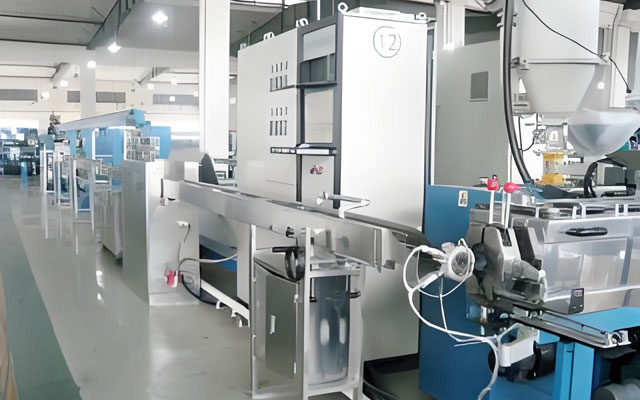
Model 50Screw Diameter φ50 mmL/D Ratio /Extrusion Output /Main Motor /Outlet Diameter /Speed 200 m/minApplication Dual-core soft optical fiber cable
Dual-Core Soft Optical Fiber Cable Extrusion Line
A dual-core soft optical fiber cable extrusion production line is a specialized set of highly automated equipment used for manufacturing dual-core soft optical fiber cables. Its core process involves using one or more extruders to simultaneously coat two parallel or slightly twisted optical fibers with molten plastic (such as PVC, LSZH, TPU, etc.), forming a unified outer sheath, ultimately producing a structurally stable and flexible dual-core optical fiber cable.
The typical structure of this cable is: two tight-buffered/bare fibers → placed parallel or slightly twisted → aramid yarn strengthening member (optional) → outer sheath. The core task of the production line is to ensure the two fibers inside the sheath are correctly positioned, symmetrically distributed, non-adhesive, and that the sheath has good roundness or a specific "figure-8" shape.
Characteristics
Precision Centering and Alignment: Equipped with special fiber guiding and alignment devices to ensure the two fibers remain parallel and symmetrical upon entering the die, preventing core misalignment.
High Bonding and Isolation Control: Through die design and process control, the bonding force between the sheath material and the fiber's tight buffer layer can be precisely controlled, allowing production of "bonded" or "non-bonded" structures as required.
Synergistic Control: The pulling, take-up, and other systems need to be highly synchronized with the extrusion system to ensure consistent tension control for both fibers, avoiding length discrepancies due to tension differences (i.e., one loose, one tight).
Flexibility: By changing dies and adjusting parameters, it can produce dual-core cables with different core diameters, different sheath thicknesses, different colors (e.g., dual-color side-by-side), and different materials.
Production Line Composition
A standard dual-core soft optical fiber cable extrusion production line adds special modules for the dual-core structure based on a single-core line. Its core components are as follows:
1. Dual Pay-Off SystemFunction: To independently and smoothly release two optical fibers (usually tight-buffered fibers) and maintain consistent tension.
Composition:
Two Independent Pay-Off Stands: Each equipped with a high-precision tension controller to ensure the pay-off tension for both fibers is minimal and equal.
Guidance and Alignment Device: This is a key component. It consists of a series of precision ceramic guide wheels that accurately guide the two independent fibers into parallel positions and ensure they enter the extrusion die with the correct spacing and attitude.
2. Pre-Treatment UnitFunction: Similar to the single-core line, but requires higher consistency in cleaning and preheating.
Composition:
Dual-Channel Cleaning Device: Cleans both fibers simultaneously.
Pre-Heater: Heats both fibers uniformly.
3. Extrusion SystemFunction: To melt plastic and uniformly coat it around the two optical fibers.
Core Components:
Extruder: Same as the single-core line, responsible for plasticizing the material.
Dual-Core Specialized Die: This is the most fundamental difference from the single-core production line. Typically, a dual-core pressure die is used.
Tip: Has two precise internal channels for the two fibers to pass through separately.
Die: Its opening shape determines the final sheath profile (circular or "figure-8").
Molten plastic converges inside the die, enveloping the two fibers to form a unified sheath. The die design must ensure balanced plastic flow, avoid weld lines, and ensure both fibers are uniformly coated.
4. Cooling SystemFunction: To set the sheath. For dual-core cables, cooling uniformity is even more critical to prevent cable bending due to uneven cooling.
Composition: Same as the single-core line, a long water trough. It is necessary to ensure the cable is evenly stressed during the cooling process.
5. Online Monitoring and Control SystemFunction: To monitor in real-time and ensure the quality of the dual-core structure.
Core Equipment:
Laser Diameter Gauge: Not only measures the outer diameter, but advanced gauges can also detect the concentricity of the sheath and the relative position of the two fibers within the sheath, ensuring no core misalignment occurs.
Dual Tension Monitoring: Monitors the tension of both fibers at the pay-off end to ensure consistency.
PLC and HMI: Centrally controls all parameters and is the "brain" of the production line.
6. Pulling SystemFunction: To provide stable pulling force. A caterpillar puller must be used to ensure uniform gripping force on both flat and round dual-core cables, avoiding slippage or product crushing.
7. Take-Up SystemFunction: Neatly winds the cable. Requires a precision traverser to adapt to the potentially wider profile of the dual-core cable and maintain constant winding tension.
8. Auxiliary EquipmentDual-Color Extrusion System (Optional): Uses two extruders and a co-extrusion die to produce dual-core cables with two colors side-by-side, facilitating fiber identification (e.g., one orange for transmit, one gray for receive).
Printing Device: Prints identification on the sheath.
Dual-Core Soft Optical Fiber Cable Extrusion Line Datasheet
| Model |
50 |
| Tight-buffered Fiber Diameter |
0.6/0.9 mm |
| Flexible Optical Cable Dimensions |
φ2-3 mm |
| Line Structure Speed |
200 m/min |
| Fiber Pay-off Tension |
0.4N~3N |
| Extruder |
φ50 |
| Take-up Tension |
5N~50N (adjustable) |
| Take-up Reel Size |
630 |
| Production Line Direction |
To be specified by customer |
| Equipment Color |
To be specified by customer |
Dual-Core Soft Optical Fiber Cable Extrusion Line Application
Dual-core soft optical fiber cables are the fundamental physical medium for building duplex (transmit/receive) communication links and are extremely widely used:
1. Equipment Interconnection & Patch Cords (Primary Application)After attaching connectors (e.g., LC, SC, ST, FC) to both ends, they become dual-core fiber optic patch cords. This is the most common type of patch cord in data centers, equipment rooms, and base stations.
Application Scenarios:
Data Centers: Connecting servers to TOR switches, switches to core switches.
Telecommunication Rooms: Cross-connections between ODFs.
Wireless Base Stations: Connecting BBU and RRU equipment.
Dual-core soft optical fiber cables are the fundamental physical medium for building duplex (transmit/receive) communication links and are extremely widely used:
1. Equipment Interconnection & Patch Cords (Primary Application)After attaching connectors (e.g., LC, SC, ST, FC) to both ends, they become dual-core fiber optic patch cords. This is the most common type of patch cord in data centers, equipment rooms, and base stations.
Application Scenarios:
Data Centers: Connecting servers to TOR switches, switches to core switches.
Telecommunication Rooms: Cross-connections between ODFs.
Wireless Base Stations: Connecting BBU and RRU equipment.
2. Fiber-to-the-HomeIn FTTH networks, dual-core soft optical fiber cables (typically G.657.A1/B6 fiber) are commonly used as drop cables from the optical splitter to the user's home. One core is used for service transmission, and the other serves as a backup, enhancing network reliability and future upgrade capability.
3. Local Area Network CablingUsed for high-speed data transmission in building riser backbones and horizontal subsystems, connecting fiber distribution boxes on different floors.
4. Sensing SystemsIn Distributed Acoustic Sensing (DAS) / Distributed Temperature Sensing (DTS) systems, dual-core cables can serve as the sensing medium, where one core is used for sensing and the other for communication backhaul.
5. Audio/Video & Professional EquipmentUsed for broadcast-grade video transmission, professional audio equipment, and other occasions requiring high bandwidth and interference immunity.
In FTTH networks, dual-core soft optical fiber cables (typically G.657.A1/B6 fiber) are commonly used as drop cables from the optical splitter to the user's home. One core is used for service transmission, and the other serves as a backup, enhancing network reliability and future upgrade capability.
3. Local Area Network CablingUsed for high-speed data transmission in building riser backbones and horizontal subsystems, connecting fiber distribution boxes on different floors.
4. Sensing SystemsIn Distributed Acoustic Sensing (DAS) / Distributed Temperature Sensing (DTS) systems, dual-core cables can serve as the sensing medium, where one core is used for sensing and the other for communication backhaul.
5. Audio/Video & Professional EquipmentUsed for broadcast-grade video transmission, professional audio equipment, and other occasions requiring high bandwidth and interference immunity.